What is the term used to describe soil that has roughly equal amounts of sand, silt, and clay?
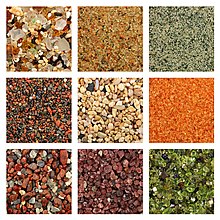
Delineation of sands:
glass, dune, quartz
volcanic, biogenic coral, pink coral
volcanic, garnet, olivine.
Samples are from the Gobi Desert, Estonia, Hawaii and the mainland United states. (1x1 cm each)[1]
Sand is a granular cloth composed of finely divided stone and mineral particles. Sand has various compositions just is defined by its grain size. Sand grains are smaller than gravel and coarser than silt. Sand tin likewise refer to a textural class of soil or soil type; i.e., a soil containing more than 85 percent sand-sized particles by mass.[ii]
The composition of sand varies, depending on the local stone sources and conditions, but the most common elective of sand in inland continental settings and non-tropical coastal settings is silica (silicon dioxide, or SiO2), ordinarily in the form of quartz.
Calcium carbonate is the second near common type of sand, for instance, aragonite, which has mostly been created, over the past 500meg years, by diverse forms of life, like coral and shellfish. For example, it is the master form of sand apparent in areas where reefs accept dominated the ecosystem for millions of years like the Caribbean. Somewhat more rarely, sand may be equanimous of calcium sulfate, such as gypsum and selenite, every bit is institute in places like White Sands National Park and Table salt Plains National Wildlife Refuge in the U.S.
Sand is a non-renewable resources over man timescales, and sand suitable for making physical is in loftier demand.[3] Desert sand, although plentiful, is not suitable for physical. 50 billion tons of beach sand and fossil sand is used each twelvemonth for construction.[4]
Limerick

Heavy minerals (dark) in a quartz embankment sand (Chennai, Republic of india)


The exact definition of sand varies. The scientific Unified Soil Classification System used in engineering and geology corresponds to US Standard Sieves, and defines sand as particles with a diameter of between 0.074 and four.75 millimeters.[5] Past another definition, in terms of particle size equally used by geologists, sand particles range in diameter from 0.0625 mm (or 1⁄16 mm) a book of approximately 0.00012 cubic millimetres, to 2 mm, a volume of approximately iv.2 cubic millimetres, the difference in volumes being 34,688 measures divergence. [half-dozen] Any particle falling inside this range of sizes is termed a sand grain. Sand grains are betwixt gravel (with particles ranging from two mm up to 64 mm past the latter organisation, and from 4.75 mm upward to 75 mm in the former) and silt (particles smaller than 0.0625 mm downwardly to 0.004 mm). The size specification betwixt sand and gravel has remained constant for more than a century, only particle diameters as small as 0.02 mm were considered sand under the Albert Atterberg standard in utilize during the early 20th century. The grains of sand in Archimedes' The Sand Reckoner written around 240 BCE, were 0.02 mm in diameter. A 1938 specification of the United States Department of Agriculture was 0.05 mm.[7] A 1953 applied science standard published by the American Clan of State Highway and Transportation Officials set up the minimum sand size at 0.074 mm. Sand feels gritty when rubbed betwixt the fingers. Silt, past comparing, feels like flour.
ISO 14688 grades sands as fine, medium, and fibroid with ranges 0.063 mm to 0.2 mm to 0.63 mm to 2.0 mm. In the United states, sand is normally divided into five sub-categories based on size: very fine sand ( 1⁄16 – 1⁄eight mm bore), fine sand ( 1⁄8 mm – 1⁄four mm), medium sand ( one⁄4 mm – 1⁄ii mm), coarse sand ( i⁄ii mm – 1 mm), and very coarse sand (1 mm – ii mm). These sizes are based on the Krumbein phi calibration, where size in Φ = -log2D; D being the particle size in mm. On this scale, for sand the value of Φ varies from −1 to +4, with the divisions between sub-categories at whole numbers.
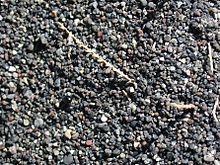
Close up of blackness volcanic sand from Perissa, Santorini, Greece
The virtually common constituent of sand, in inland continental settings and non-tropical coastal settings, is silica (silicon dioxide, or SiO2), usually in the grade of quartz, which, because of its chemical inertness and considerable hardness, is the most common mineral resistant to weathering.
The composition of mineral sand is highly variable, depending on the local stone sources and conditions. The vivid white sands plant in tropical and subtropical coastal settings are eroded limestone and may incorporate coral and shell fragments in improver to other organic or organically derived fragmental material, suggesting that sand formation depends on living organisms, too.[8] The gypsum sand dunes of the White Sands National Park in New United mexican states are famous for their vivid, white colour. Arkose is a sand or sandstone with considerable feldspar content, derived from weathering and erosion of a (usually nearby) granitic rock outcrop. Some sands contain magnetite, chlorite, glauconite, or gypsum. Sands rich in magnetite are dark to black in colour, equally are sands derived from volcanic basalts and obsidian. Chlorite-glauconite begetting sands are typically green in color, as are sands derived from basaltic lava with a high olivine content. Many sands, especially those found extensively in Southern Europe, take atomic number 26 impurities inside the quartz crystals of the sand, giving a deep yellow color. Sand deposits in some areas contain garnets and other resistant minerals, including some small gemstones.
Sources
Rocks erode or weather over a long menstruum of time, mainly by water and wind, and their sediments are transported downstream. These sediments continue to intermission apart into smaller pieces until they become fine grains of sand. The blazon of rock the sediment originated from and the intensity of the environment give different compositions of sand. The most common stone to form sand is granite, where the feldspar minerals deliquesce faster than the quartz, causing the rock to interruption apart into minor pieces. In loftier energy environments rocks break apart much faster than in more calm settings. In granite rocks this results in more than feldspar minerals in the sand because they don't have equally much time to dissolve abroad. The term for sand formed by weathering is "epiclastic."[ix]
Sand from rivers are collected either from the river itself or its flood plain and accounts for the majority of the sand used in the structure manufacture. Because of this, many small-scale rivers have been depleted, causing environmental concern and economic losses to next country. The rate of sand mining in such areas greatly outweighs the rate the sand can replenish, making it a non-renewable resources.[10]
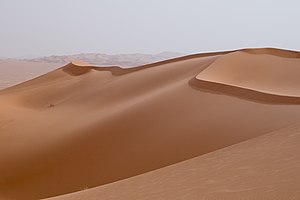
Sand dunes are a upshot of dry out conditions or wind deposition. The Sahara Desert is very dry considering of its geographic location and proximity to the equator. It is known for its vast sand dunes, which exist mainly due to a lack of vegetation and water. Over time, air current blows away fine particles, such as clay and dead organic matter, leaving only sand and larger rocks. Only 15% of the Sahara is sand dunes, while seventy% is bare rock.[11] The wind is responsible for creating these different environments and shaping the sand to exist round and smooth. These backdrop make desert sand unusable for structure.[12]
Beach sand is as well formed by erosion. Over thousands of years, rocks are eroded almost the shoreline from the constant motility of waves and the sediments build up. Weathering and river deposition as well accelerate the process of creating a beach, along with marine animals interacting with rocks, such every bit eating the algae off of them. In one case there is a sufficient corporeality of sand, the beach acts as a barrier to keep the land from eroding any further. This sand is ideal for construction as information technology is angular and of various sizes.[13]
Marine sand (or ocean sand) comes from sediments transported into the bounding main and the erosion of ocean rocks. The thickness of the sand layer varies, all the same it is common to have more sand closer to land; this type of sand is ideal for construction and is a very valuable commodity. Europe is the principal miners of marine sand, which profoundly hurts ecosystems and local fisheries.[ten]
Study
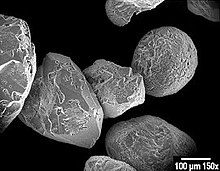
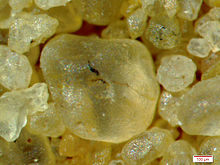
Pitted sand grains from the Western Desert, Arab republic of egypt. Pitting is a consequence of current of air transportation.
The study of private grains can reveal much historical information as to the origin and kind of transport of the grain.[14] Quartz sand that is recently weathered from granite or gneiss quartz crystals volition be angular. It is called grus in geology or sharp sand in the building trade where it is preferred for concrete, and in gardening where it is used as a soil subpoena to loosen clay soils. Sand that is transported long distances by water or wind will be rounded, with feature abrasion patterns on the grain surface. Desert sand is typically rounded.
People who collect sand as a hobby are known equally arenophiles. Organisms that thrive in sandy environments are psammophiles.[15]
Uses

Sand grains of yellowish edifice sand. Microscope Lumam P-8. EPI lighting. The photo of each grain of sand is the result of multifocal stacking.
- Abrasion: Before sandpaper, wet sand was used as an abrasive element between rotating devices with elastic surface and hard materials such as very hard stone (making of rock vases), or metallic (removal of old stain earlier re-staining copper cooking pots).
- Agriculture: Sandy soils are platonic for crops such as watermelons, peaches, and peanuts, and their fantabulous drainage characteristics make them suitable for intensive dairy farming.
- Air filtration: Finer sand particles mixed with cloth was usually used in certain gas mask filter designs merely have largely been replaced by microfibers.
- Aquaria: Sand makes a low-cost aquarium base of operations material which some believe is better than gravel for home employ. Information technology is also a necessity for saltwater reef tanks, which emulate environments composed largely of aragonite sand broken downwards from coral and shellfish.
- Artificial reefs: Geotextile bagged sand can serve every bit the foundation for new reefs.
- Artificial islands in the Western farsi Gulf.
- Beach nourishment: Governments movement sand to beaches where tides, storms, or deliberate changes to the shoreline erode the original sand.[16]
- Brick: Manufacturing plants add together sand to a mixture of dirt and other materials for manufacturing bricks.[17]
- Cob: Coarse sand makes up every bit much every bit 75% of cob.
- Concrete: Sand is oft a master component of this critical construction material.
- Glass: Sand rich in silica is the principal component in mutual glasses.
- Hydraulic fracturing: A drilling technique for natural gas, which uses rounded silica sand as a "proppant", a cloth to concord open up cracks that are caused by the hydraulic fracturing process.
- Landscaping: Sand makes pocket-sized hills and slopes (golf courses would be an case).
- Mortar: Sand is mixed with masonry cement or Portland cement and lime to be used in masonry construction.
- Pigment: Mixing sand with paint produces a textured terminate for walls and ceilings or non-slip floor surfaces.
- Railroads: Engine drivers and rail transit operators employ sand to improve the traction of wheels on the rails.
- Recreation: Playing with sand is a favorite beach activity. One of the about dear uses of sand is to make sometimes intricate, sometimes simple structures known equally sand castles, proverbially impermanent. Special play areas for children, enclosing a significant area of sand and known every bit sandboxes, are common on many public playgrounds, and even at some single-family unit homes. Sand dunes are also popular amid climbers, motorcyclists and beach buggy drivers.
- Roads: Sand improves traction (and thus traffic safety) in icy or snowy weather.
- Sand animation: Performance artists draw images in sand. Makers of animated films use the same term to draw their use of sand on frontlit or backlit glass.
- Sand casting: Casters moisten or oil molding sand, also known every bit foundry sand so shape it into molds into which they cascade molten cloth. This type of sand must be able to withstand high temperatures and pressure, allow gases to escape, have a uniform, small grain size, and be not-reactive with metals.
- Sandbags: These protect against floods and gunfire. The cheap bags are easy to ship when empty, and unskilled volunteers tin quickly fill them with local sand in emergencies.
- Sandblasting: Graded sand serves every bit an annoying in cleaning, preparing, and polishing.
- Silicon: Quartz sand is a raw material for the product of silicon.
- Thermal weapon: While non in widespread apply anymore, sand used to be heated and poured on invading troops in the classical and medieval time periods.
- H2o filtration: Media filters use sand for filtering water. Information technology is too commonly used by many water handling facilities, oftentimes in the form of rapid sand filters.
- Wuḍūʾ: an Islamic ritual wiping of parts of the body.
- Zoanthid "skeletons": Animals in this order of marine benthic cnidarians related to corals and bounding main anemones, incorporate sand into their mesoglea for structural forcefulness, which they demand because they lack a true skeleton.
Resource and ecology concerns
Just some sands are suitable for the construction industry, for example for making concrete. Considering of the growth of population and of cities and the consequent construction activity there is a huge demand for these special kinds of sand, and natural sources are running low. In 2012 French managing director Denis Delestrac fabricated a documentary chosen "Sand Wars" about the affect of the lack of construction sand. It shows the ecological and economic effects of both legal and illegal trade in construction sand.[eighteen] [19] [twenty]
To recall the sand, the method of hydraulic dredging is used. This works by pumping the height few meters of sand out of the water and filling it into a gunkhole, which is then transported dorsum to state for processing. Unfortunately, all marine life mixed in with the extracted sand is killed and the ecosystem can continue to endure for years after the mining is complete. Not merely does this affect marine life, but also the local fishing industries because of the loss of life, and communities living close to the h2o's edge. When sand is taken out of the h2o it increases the take a chance of landslides, which can pb to loss of agricultural country and/or damage to dwellings.[21]
Sand's many uses require a significant dredging industry, raising environmental concerns over fish depletion, landslides, and flooding.[22] Countries such as Cathay, Indonesia, Malaysia, and Kingdom of cambodia ban sand exports, citing these problems as a major factor.[23] It is estimated that the annual consumption of sand and gravel is 40 billion tons and sand is a US$70 billion global industry.[24] With increasing utilise, more is expected to come up from recycling and alternatives to sand.[25]
The global demand for sand in 2017 was 9.55 billion tons as part of a $99.5 billion manufacture.[26]
Hazards
While sand is mostly not-toxic, sand-using activities such every bit sandblasting require precautions. Numberless of silica sand used for sandblasting now carry labels alert the user to wear respiratory protection to avoid breathing the resulting fine silica grit. Rubber information sheets for silica sand state that "excessive inhalation of crystalline silica is a serious health business organisation".[27]
In areas of high pore water force per unit area, sand and salt water can form quicksand, which is a colloid hydrogel that behaves like a liquid. Quicksand produces a considerable barrier to escape for creatures caught within, who frequently die from exposure (not from submersion) as a event.
Manufacture
Manufactured sand (M sand) is sand made from rock by artificial processes, usually for construction purposes in cement or concrete. It differs from river sand past being more athwart, and has somewhat different properties.[28]
Case studies
In Dubai, United Arab Emirates, the apply of sand has been very demanding in the construction of infrastructure and creating new islands. They used up their own reserves and also imported sand from Australia. There have been three projects to create bogus islands needing more than 835 million tonnes of sand, which cost more than US$26 billion.[29]
See also
 World Sciences portal
- Aggregate (geology) – Mass of rock, gravel, sand, soil particles, or of minerals in a rock
- Beach – Area of loose particles at the edge of the sea or other torso of water
- Construction aggregate – Coarse to fine grain stone materials used in concrete
- Coral Pink Sand Dunes Land Park – Land park in Utah, US
- Desert sand (color)
- Dry quicksand
- Energetically modified cement – Grade of cements, mechanically candy to transform reactivity (EMC)
- Heavy mineral sands ore deposits
- Oil sands – Blazon of unconventional oil deposit
- Papakolea Embankment – Dark-green sand beach in Kaʻū district, Hawai'i, US
- Particle size – Notion
- Punaluʻu Beach – Blackness Sand Embankment, Large Isle, Hawaii, United states
- Quicksand – Mixture of sand, silt or clay with water, which creates a liquefied soil when agitated
- Red Sand Beach – Kaihalulu Beach, Maui, Hawaii, US
- Revolving rivers
- Sand Embankment, disambiguation
- Sand island – Island that is largely fabricated of sand
- Sand mining
- Sand rat – Genus of rodents
- Sandstone – Type of sedimentary rock
- Sandstorm – Meteorological phenomenon common in arid and semi-barren regions
- Sand theft – Unauthorized and/or illegal mining of sand
- Singing sand – A miracle of sand that produces audio
- White Sands National Park
References
- ^ Siim Sepp. "Sand types". sandatlas.org. Archived from the original on 13 August 2019. Retrieved 17 February 2020.
- ^ Glossary of terms in soil science (PDF). Ottawa: Agronomics Canada. 1976. p. 35. ISBN978-0662015338. Archived (PDF) from the original on 14 February 2019. Retrieved 11 August 2014.
- ^ Constable, Harriet (three September 2017). "How the demand for sand is killing rivers". BBC News Magazine. Archived from the original on 3 September 2017. Retrieved nine September 2017.
- ^ Albarazi, Hannah. "The Glace Slopes of the Earth Sand Shortage". Archived from the original on 29 March 2019. Retrieved 29 March 2019.
- ^ Unified Soil Classification Organization [ permanent dead link ]
- ^ Pettijohn, FJ; Potter, PE; Siever, Raymond (1972). Sand and Sandstone. New York: Springer Verlag. p. one. ISBN9780387900711. Archived from the original on 2 July 2021. Retrieved ix March 2021.
- ^ Urquhart, Leonard Church, "Civil Applied science Handbook" McGraw-Hill Book Visitor (1959) p. 8-2
- ^ Seaweed also plays a role in the formation of sand Archived ane July 2017 at the Wayback Automobile. Susanscott.net (1 March 2002). Retrieved on 24 November 2011.
- ^ Gilman, Larry (2014). Sand. Vol. 7 (5 ed.). The Gale Encyclopedia of Scientific discipline. pp. 3823–3824.
- ^ a b Padmalal, Maya (2014). "Sources of Sand and Conservation". Sand Mining. Springer, Dordrecht. pp. 155–160. ISBN978-94-017-9143-4.
- ^ "Sahara". The Columbia Encyclopedia (six ed.). Columbia University Printing. 2000. ISBN9780787650155.
- ^ "What is the reason for not using sea and desert sand for construction?". The Hindu. two August 2015. ISSN 0971-751X. Archived from the original on fifteen December 2019. Retrieved ix April 2019.
- ^ "How Is A Embankment Formed?". WorldAtlas. 19 December 2017. Archived from the original on 13 December 2019. Retrieved x April 2019.
- ^ Krinsley, D.H., Smalley, I.J. 1972. Sand. American Scientist lx, 286–291
- ^ "Psammophile". Merriam-Webster.com. Archived from the original on 9 July 2017. Retrieved 27 Jan 2016.
- ^ "Importing Sand, Drinking glass May Aid Restore Beaches". NPR.org. 17 July 2007. Archived from the original on ii July 2021. Retrieved 4 Apr 2018.
- ^ Yong, Syed E. Hasan, Benedetto De Vivo, Bernhard Grasemann, Kurt Stüwe, January Lastovicka, Syed Thousand. Hasan, Chen (5 December 2011). Ecology and Engineering Geology -Book III. EOLSS Publications. p. eighty. ISBN978-1-84826-357-4. Archived from the original on 2 July 2021. Retrieved 19 October 2019.
- ^ Run across Sand Wars teaser Archived 8 February 2011 at the Wayback Auto here.
- ^ Simon Ings (26 April 2014). "The story of climate change gets star treatment". New Scientist: 28–ix. Archived from the original on iv November 2014. Retrieved 29 May 2019.
- ^ Strände in Gefahr? Archived 24 September 2015 at the Wayback Car Arte Future, last updated 23 Apr 2014
- ^ Kim, Tae Goun (14 September 2007). "The economic costs to fisheries because of marine sand mining in Ongjin Korea: Concepts, methods, and illustrative results". Ecological Economics. 65 (three): 498–507. doi:x.1016/j.ecolecon.2007.07.016.
- ^ Torres, Aurora; et al. (8 September 2017). "The earth is facing a global sand crunch". The Conversation. Archived from the original on ix July 2018. Retrieved ix September 2017.
- ^ "The hourglass effect". The Economist. 8 October 2009. Archived from the original on 16 December 2018. Retrieved 14 October 2009.
- ^ Beiser, Vince (26 March 2015). "The Deadly Global War for Sand". Wired. Archived from the original on 16 April 2018. Retrieved 26 March 2015.
- ^ Torres, Aurora; Simoni, Mark U.; Keiding, Jakob G.; Müller, Daniel B.; zu Ermgassen, Sophus O.Southward.E.; Liu, Jianguo; Jaeger, Jochen A.G.; Wintertime, Marten; Lambin, Eric F. (May 2021). "Sustainability of the global sand system in the Anthropocene". One Earth. 4 (5): 639–650. Bibcode:2021OEart...iv..639T. doi:10.1016/j.oneear.2021.04.011.
- ^ Doyle, Alister (11 Feb 2019). "As ice melts, Greenland could become big sand exporter: study". reuters.com. Archived from the original on vii August 2020. Retrieved 12 February 2019.
- ^ Silica sand MSDS Archived xi March 2006 at the Wayback Motorcar. Simplot (13 March 2011). Retrieved on 24 November 2011.
- ^ Pilegis, M.; Gardner, D.; Lark, R. (2016). "An Investigation into the Use of Manufactured Sand as a 100% Replacement for Fine Aggregate in Physical". Materials. ix (half dozen): 440. Bibcode:2016Mate....nine..440P. doi:ten.3390/ma9060440. PMC5456819. PMID 28773560.
- ^ PEDUZZI, Pascal (April 2014). "Sand, rarer than one thinks". Ecology Development. xi: 208–218. doi:10.1016/j.envdev.2014.04.001. Archived from the original on 29 May 2019. Retrieved 29 May 2019.
External links
 | Expect upwards sand in Wiktionary, the costless lexicon. |
 | Wikiquote has quotations related to: Sand |
 | Wikimedia Commons has media related to Sand. |
- Beach Sand: What It Is, Where Information technology Comes From and How It Gets Here - Beaufort County Library
- Embankment, Chandler B., ed. (1914). . . Chicago: F. E. Compton and Co.
- Sand mining side-effects
- The World Is Running Out Of Sand - New York Times
- Sand Mining In Republic of india Rivers Causing Problems - New York Times
- How Need For Sand Is Killing Rivers In Africa - BBC
- Dubai Imports Sand - BBC
Source: https://en.wikipedia.org/wiki/Sand
0 Response to "What is the term used to describe soil that has roughly equal amounts of sand, silt, and clay?"
Post a Comment